Friends of Port Chicago National Memorial
  • Home
  • About
    • Board of Directors
  • Visiting the Memorial
  • The Disaster
  • Exoneration
  • Events
  • In the News
  • Fundraiser
    • Donate
  • Contact

Category: Uncategorized

The Port Chicago 50 at 76: Time for Exoneration by Thurgood Marshall, Jr. and John A. Lawrence

  • July 17, 2020
  • by Keith Kamisugi
  • · Uncategorized

Originally posted on nationalww2museum.org.

July 17, 2020 marks the 76th anniversary of a frequently overlooked episode during World War II that had profound changes on the US military and the legal and social structure of American society. As with many aspects of our history involving equity and justice, the events surrounding what happened at  the Port Chicago Naval Magazine that night continue to affect our perceptions of history and the legal system decades later.

Whether by choice or by circumstance, the US military has been at the forefront of social change, especially when it comes to matters of diversity and equality, gender, and sexual preference. The aftermath of the Port Chicago disaster compelled a re-evaluation of the role of racial minorities in the military following World War II, a consequential prologue to the broader civil rights movement that changed America.

The disparate treatment of African Americans during World War II era is well-documented; minorities (especially Black and Asian citizens) whether or not they wore the uniform. During the war, stories of the indignities and violence circulated widely and the black press, and civil rights leaders pressured the Roosevelt administration for serious action to address discrimination. 

At Port Chicago, Black sailors who had been trained for combat roles were instead relegated to loading munitions aboard ships under the supervision of white officers. A premium was placed on speed and efficiency; the officers would conduct “races” among teams of loaders with little regard for safety. Neither the Black sailors nor the officers were trained adequately for the dangerous work; many loaders reported they were not even given gloves for handling the 600 pound bombs and other munitions including highly volatile incendiaries fitted with detonators. So little training was provided while the longshore union warned that a catastrophe was imminent.

On July 17, that admonition came true with almost unimaginable consequences. For reasons that can never be accurately determined, a cataclysmic series of explosions—the largest man-made detonation in history to that point—erupted with the force of 5,000 tons of TNT. Instantly, 320 men, two-thirds of them African American, were killed and hundreds more were injured. The ships they were loading were nearly obliterated; a locomotive evaporated. The force of the blasts was felt 20 miles away in San Francisco.
Read the full article.

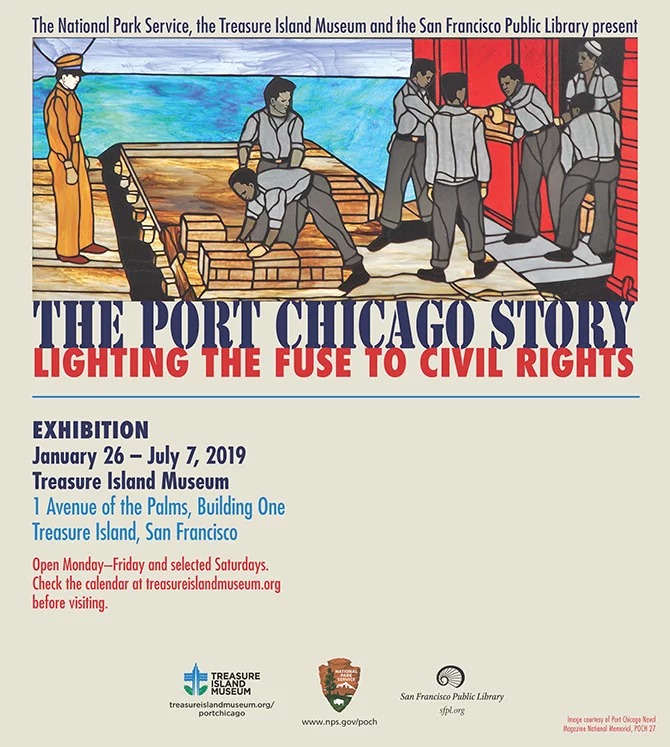
Treasure Island Museum Honors Black History Month: ‘Lighting the Fuse to Civil Rights: The Port Chicago Trial on Treasure Island’

  • January 18, 2019
  • by Keith Kamisugi
  • · Uncategorized

Video: Thuy Vu of KQED Newsroom on February 8, 2019, interviewed Walt Bilofsky, President of the Treasure Island Museum, and Mary Wardell-Ghirarduzzi, chief diversity officer at the University of San Francisco, on the Port Chicago disaster and the new exhibit at the Treasure Island Museum.

An exhibition on Port Chicago is on view at the Treasure Island Museum, Building One lobby, through July 9, presented by the S.F. Public Library and the Port Chicago Naval Magazine National Memorial.

On February 9, 2019, the Treasure Island Museum, in partnership with the Port Chicago Naval Magazine National Memorial, the San Francisco Public Library and the Friends of Port Chicago Memorial, presented a lecture and symposium on Port Chicago.

Friends of Port Chicago board member David Salniker was one of the panelists.

This Black History Month program presented one of the earliest steps forward toward civil rights, part of which took place on Naval Station Treasure Island, in the city of San Francisco.

75 years ago, during World War II, a massive explosion at the Port Chicago Naval Magazine near Concord killed 320 people, most of them African-American sailors ordered to load explosives with no training  and inadequate equipment and safety precautions.

​Weeks later, 50 sailors refused to resume that work. Their ensuing mutiny convictions, in a trial held on Naval Station Treasure Island, shone a spotlight on racism in the military, leading 16 months later to the desegregation of the Navy, and two years later all the armed services.

​The program presented the story of the disaster and trial. A panel of experts discussed how these events contributed to the mid century modern civil rights movement, and how they inform issues still being dealt with today.

Oak Dowling, JD, Instructor at Dominican University presented The Port Chicago Story, with a panel discussion with: Prof. Rhonda Magee, USF School of Law; Prof. James Taylor, USF Dept. of African American Studies; Kelli English, Chief of Interpretation, Port Chicago Naval Magazine; David Salniker, Board Member, Friends of Port Chicago National Memorial; and moderated by Mary Wardell-Ghirarduzzi, Vice Provost for Diversity Engagement and Community Outreach, USF.

Treasure Island Museum Honors Black History Month Lighting the Fuse to Civil Rights The Port Chicago Trial on Treasure Island

Create a website or blog at WordPress.com

  • Twitter
  • Facebook
  • Subscribe Subscribed
    • Friends of Port Chicago National Memorial
    • Already have a WordPress.com account? Log in now.
    • Friends of Port Chicago National Memorial
    • Subscribe Subscribed
    • Sign up
    • Log in
    • Report this content
    • View site in Reader
    • Manage subscriptions
    • Collapse this bar
 

Loading Comments...